7 Days Return
Without any damage
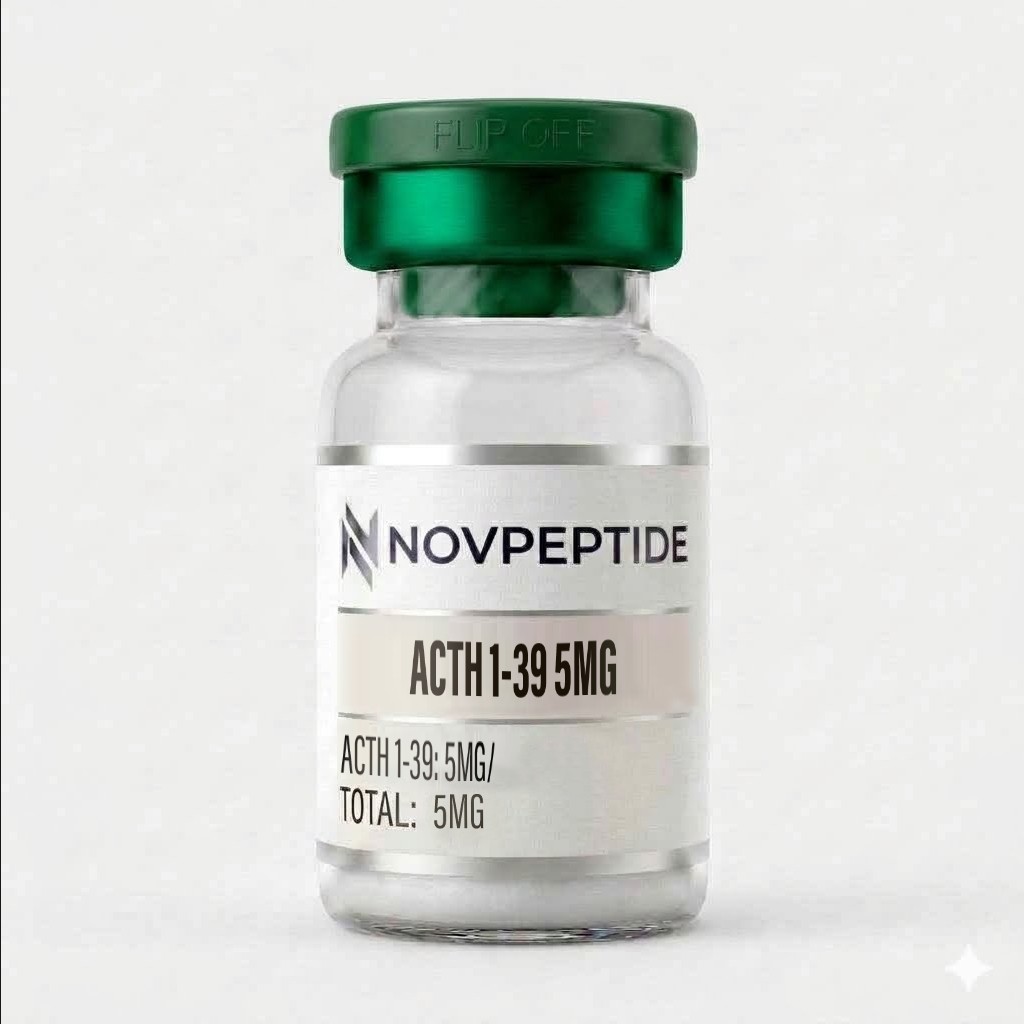
ACTH (1-39) Peptide: Advances in Research on Mechanisms of Action, Metabolic Regulation, and Tissue Protection
The ACTH (1-39) peptide—specifically, full-length Adrenocorticotropic Hormone—is a single-chain polypeptide composed of 39 amino acid residues. Structurally, it represents the core active fragment generated from Pro-opiomelanocortin (POMC) through cleavage by specific proteolytic enzymes.
(1) Studies indicate that this endogenous polypeptide, acting as a classic neuroendocrine regulatory factor, primarily targets the native Melanocortin 2 Receptor (MC2R) located on the surface of cells within the zona fasciculata of the adrenal cortex via the circulatory system, thereby initiating downstream signaling cascades. The melanocortin receptor family comprises five subtypes (MC1R–MC5R); interestingly, ACTH (1-39) is currently the only known natural ligand exhibiting absolute selectivity and high affinity for MC2R. The discovery of this peptide dates back to the mid-20th century, and subsequent comparative studies have confirmed its pivotal role in regulating the synthesis and secretion of glucocorticoids (such as corticosterone and cortisol).
(2) Furthermore, recent studies have demonstrated that the signaling pathways of ACTH (1-39) are not confined solely to the adrenal axis; it also binds with high affinity to MC1R, MC3R, and MC5R receptors located on the surface of immune cells and adipocytes, triggering signaling cascades involving cAMP/PKA. This process is critical for maintaining the body's immune homeostasis, anti-inflammatory responses, and energy balance. Chemical Composition and Physical Properties
Molecular Formula: C207H308N56O58S1
Molecular Weight: 4541.1 Da
Other Known Names: Corticotropin, Human Adrenocorticotropic Hormone (1-39)
Amino Acid Sequence: SYSMEHFRWGKPVGKKRRPVKVYPNGAEDESAEAFPLEF
Research and Clinical Trials
ACTH (1-39) in Immunomodulation and Cytoprotection
In a double-blind, placebo-controlled experimental study, researchers investigated the potential protective effects of ACTH (1-39) in an acute inflammation model and conducted pharmacokinetic analyses.
(3) According to the pharmacokinetic analysis report, due to degradation by plasma endopeptidases, the intravenous half-life (T1/2) of natural ACTH (1-39) is relatively short (approximately 15 to 30 minutes); however, its biological effects within local tissues can persist for several hours. Preliminary results from this study suggest that single or repeated administration of ACTH (1-39) may lead to a significant reduction in pro-inflammatory cytokines. This conclusion is based on observations of histopathological changes in synovial and neural tissues—changes that were quantified following peptide exposure using specific measurement techniques such as quantitative polymerase chain reaction (qPCR) and enzyme-linked immunosorbent assay (ELISA). The results indicated a significant decline in inflammatory biomarkers. Specifically, the researchers noted:
“During the experimental observation period, histological assessments revealed statistically significant reductions in both mean systemic inflammatory factor expression (TNF-α decreased by 33.5%; P = 0.01) and local tissue edema volume (decreased by 25.1%; P = 0.02; measured via high-resolution ultrasound).”
Furthermore, distinct changes were observed in serum biomarkers, suggesting a potential phenotypic shift in macrophages from the M1 type (pro-inflammatory) to the M2 type (anti-inflammatory). ACTH (1-39), Lipid Metabolism, and Adipose Differentiation
Based on a review of numerous scientific studies, the expression of the melanocortin system is frequently found to be in a state of imbalance in models of obesity or metabolic disorders.
(4) For instance, in mouse models utilized to study metabolic syndrome, levels of MC2R and MC5R within adipose tissue may undergo compensatory alterations. More specifically, under experimental conditions, acute exposure to ACTH (1-39) appears to be associated with increased lipid mobilization and the activation of adipose triglyceride lipase (ATGL). This suggests that ACTH (1-39) possesses the potential to directly promote lipolysis—a process that does not rely entirely on systemic metabolism mediated by adrenocortical hormones. Conversely, chronic exposure may lead to adipose tissue redistribution via corticosteroid-mediated pathways. The review further highlights that, in specific cellular models, a deficiency in ACTH (1-39) or receptor desensitization may result in increased lipid accumulation. This phenomenon is attributed to two primary mechanisms:
Potential downregulation of lipolysis-related enzymes: A lack of effective ACTH stimulation may reduce the phosphorylation levels of hormone-sensitive lipase (HSL), thereby diminishing the oxidative release of fatty acids.
Influence on preadipocyte differentiation: Acting through peripheral melanocortin receptors, ACTH (1-39) may modulate the storage capacity and differentiation trajectory of peripheral adipose tissue.
Consequently, researchers have administered ACTH (1-39) in specific models of metabolic dysfunction, revealing that this peptide exerts a complex, bidirectional regulatory influence on energy partitioning and the mitigation of aberrant lipid accumulation. (5)
ACTH (1-39) and Neuromuscular Excitability
Ongoing scientific investigations suggest that the potential functions of this peptide may extend beyond the endocrine axis.
(6) Through neuroprotective and neurotrophic mechanisms, this peptide may help sustain the viability of spinal motor neurons, thereby preserving the signaling efficiency of neuromuscular junctions. These observations were derived from measurements obtained via electromyography (EMG) and microneurography in mouse models of neuronal injury. More specifically, exposure to ACTH (1-39) was associated with a significant reduction in the rate of neuronal apoptosis, without altering the anatomical typing of basal muscle fibers. This suggests that the peptide may exert its effects primarily by improving the neurotrophic environment rather than by directly promoting muscle hypertrophy. Furthermore, the maintenance of nerve conduction velocity and action potential amplitude was observed in the experimental models, indicating that neuromuscular function may be preserved. In standardized fatigue tests, nerve injury models exposed to ACTH (1-39) demonstrated improved innervation capacity, with maximum absolute contractile force remaining stable within a specific time window.
ACTH (1-39) and Bone and Mineral Metabolism
Another study investigated the dual effects of ACTH (1-39) on bone tissue within the context of autoimmune disease models.
(7) The study noted that the actions of ACTH (1-39) possess a unique complexity: on one hand, the endogenous glucocorticoids activated by the peptide carry potential osteoporotic side effects (specifically, the induction of osteoblast apoptosis); yet, on the other hand—as discovered in recent years—ACTH (1-39) can act directly upon melanocortin receptors located on the surface of osteoblasts, thereby exerting a direct osteoprotective effect. Micro-CT analysis of bone tissue revealed that, within an experimental design specifically controlled to exclude the confounding effects of systemic cortisol excess, the direct administration of ACTH (1-39) stimulated osteoblast proliferation via a direct pathway and, to a certain extent, counteracted osteoclast activity. Histological analysis suggested that this direct action contributed to the preservation of trabecular bone microstructure in specific models of inflammatory bone loss. The researchers noted:
“The direct activation of peripheral receptors by ACTH (1-39) translated, to some extent, into a resistance against increased bone fragility during biomechanical testing; specifically, against the backdrop of inflammatory bone loss, the observed reductions in both bone stiffness and maximum load-bearing capacity were less pronounced than those observed in the placebo control group.”